Practical guide
Choosing a Taxi in Sweden
A quick checklist for choosing a taxi in Sweden: check the vehicle, price information, comparison price and fare method before you get in.
Quick checklist
Before you get in
These checks are designed to take less than a minute when you are choosing a taxi.
- Check that it is a taxi
A taxi-registered vehicle in Sweden has yellow number plates. The driver’s taxi identity card must be prominently displayed in the vehicle.
- Read the price information before you get in
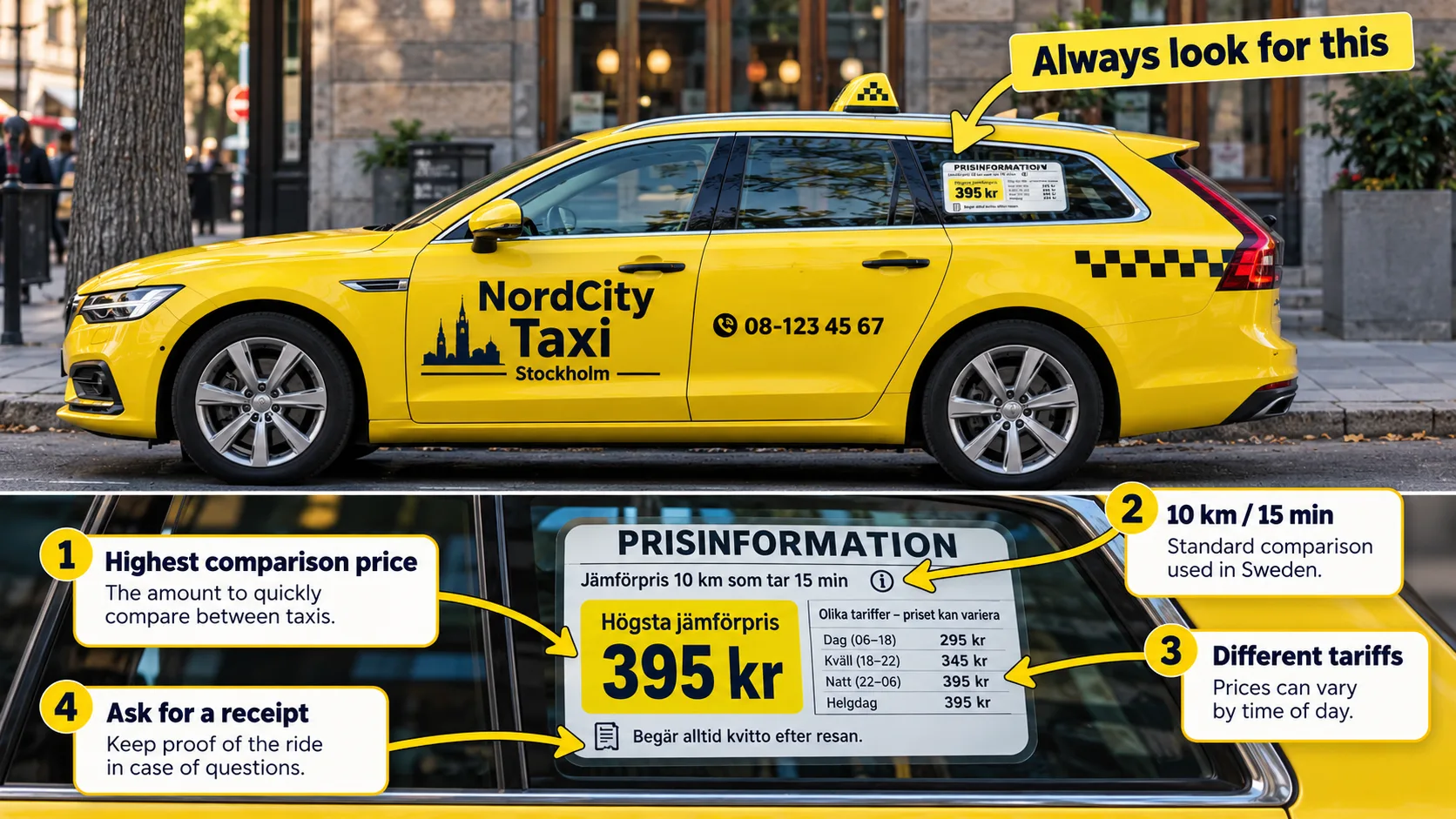
Taxi fares are freely set and can differ substantially. Price information must be displayed clearly on the outside and inside of the vehicle.
- Look at the comparison price
The comparison price is a standardised 10 km / 15 minute price, including VAT and any basic charge. Use it to compare tariff levels — it is not a quote for your journey.
- Know how the fare will be determined
For a taximeter-equipped taxi, ask whether the journey will be metered or whether a fixed price is available. Sweden also permits a separate pre-booked fixed-price system using approved special equipment instead of a taximeter.
- Clarify anything you do not understand before departure
You are free to choose the taxi that suits you. At a taxi queue, you do not have to take the first car.
Quick decision example
Why these checks matter
Sweden uses free pricing for taxi journeys. There is no general national maximum fare, and prices can vary between companies, times and days. This makes the information available before the journey particularly important.
Taxi-registered vehicles must display price information clearly on the outside and inside. For taxis using comparison prices, the comparison price represents a standardised journey of 10 kilometres lasting 15 minutes, including VAT and any basic charge. It is useful for comparing tariff levels, but it is not a quote for the trip you are about to take.
A taxi-registered vehicle has yellow number plates. The driver must hold a taxi driver licence and the driver’s identity card must be prominently displayed in the vehicle. The six-digit driver code can help identify the driver if you later need to make a complaint.
Expensive does not automatically mean wrong
A higher price is not, by itself, evidence that a taxi service is unlawful or poor value. You may deliberately choose a premium vehicle or service and decide that the higher price is worthwhile.
The practical issue is whether you understand the offer before accepting the journey. If two taxis provide the type of service you want but have very different tariff levels, the displayed price information lets you make that choice knowingly.
Choosing a taxi at an airport
Airports can have their own taxi arrangements in addition to the national rules. Do not assume that the procedure is identical at every airport.
At Stockholm Arlanda Airport, Swedavia advises passengers to follow signs for Taxi, Approved Taxi and use airport-approved taxis. Swedavia-contracted taxis are subject to airport-specific conditions, including maximum fares within a defined zone. A driver approaching passengers inside the arrivals hall is not the same as a taxi waiting in the approved taxi area; only drivers meeting passengers for pre-booked cars are allowed inside the arrivals hall for that purpose.
See Taxi at Stockholm Arlanda Airport before relying on airport-specific prices or procedures, as these arrangements can change.
After the journey
If the taxi uses a taximeter, make sure you are offered the taximeter receipt when the journey ends. It contains identifying information including the vehicle registration number and details about the taxi company and driver. Keep it, particularly if you may need to report a problem or recover something left in the vehicle.
For payment methods, receipts and what information to keep, continue to Payment & Receipts.